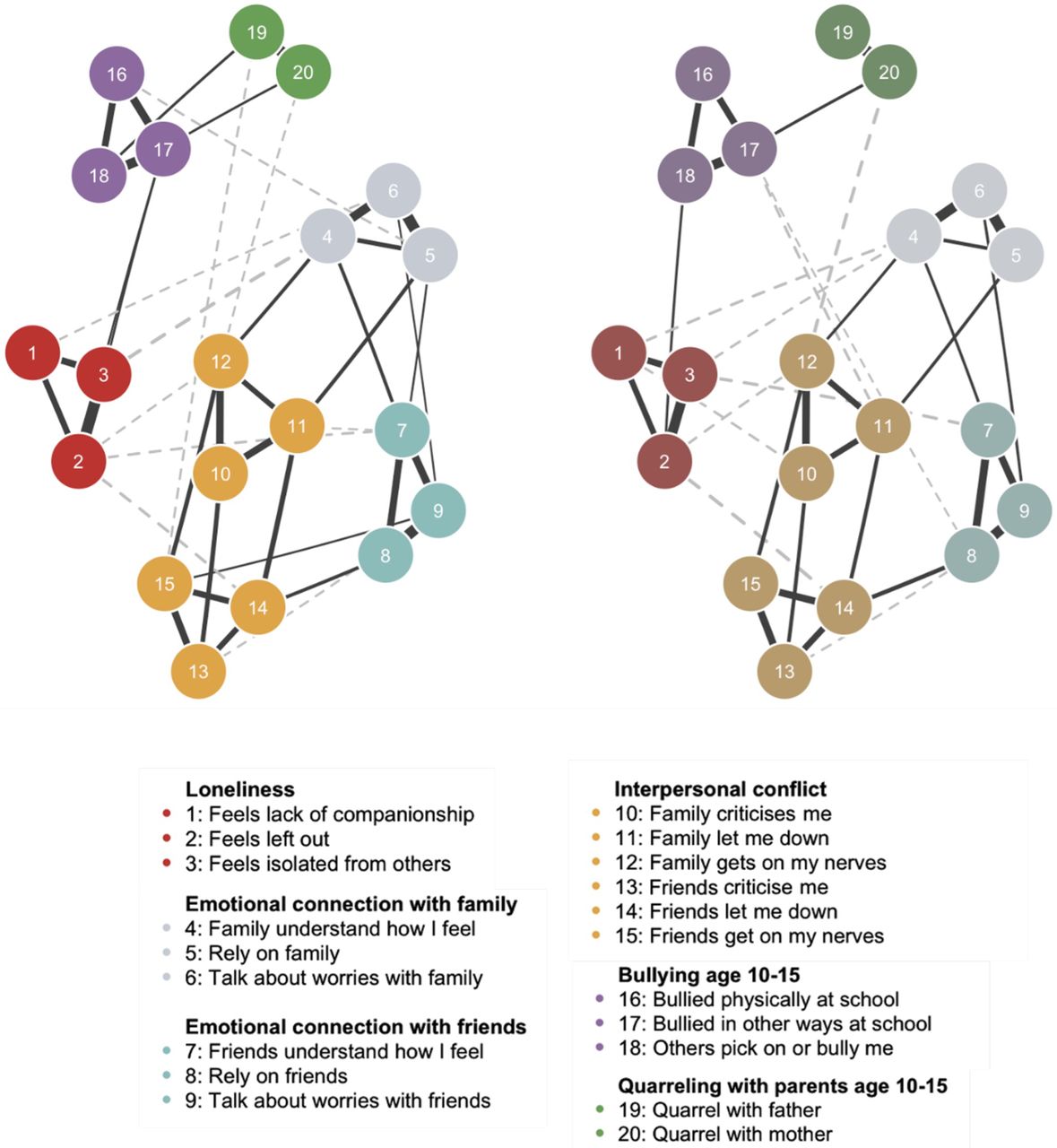
 Networks of bullying and family conflict age 10–15 years, loneliness and social connection age 16–24 years for high (left) and low (right) socioeconomic marginalisation groups
Our recent study, led by Dr Kathryn Bates and published in BMJ Public Health, shows that family relationships remain important in late adolescence. data from the UK Household Longitudinal Survey (N=2531), we captured loneliness and social connection at 16–24 years and bullying and family conflict at 10–15 years. Network analysis tested item-level relationships while controlling for other variables.
What is already known about the topic:
- Adolescents from low socioeconomic backgrounds often report higher levels of loneliness.
- Previous literature testing the relationship between socioeconomic status and loneliness is often limited to (1) single item or composite scores of loneliness and (2) socioeconomic status measures that do not account for marginalisation.
What this study adds:
- This study shows that specific facets of loneliness are linked to distinct aspects of social connection and past peer bullying.
- Family and friend relationships, as well as past peer bullying, remain important in loneliness and social connection networks even in late adolescence.
- Adolescents experiencing high socioeconomic marginalisation are more likely to report more severe bullying, and some relationships between specific aspects of loneliness and social connection were stronger in this group.
How this study might affect research, practice or policy:
- The study shows the value of investigating item-level dynamics in loneliness, social connection and bullying to identify suitable targets for support.
- Confirmatory and intervention studies should consider the multidimensionality of loneliness and social connection.
- Policies addressing adolescent psychosocial health should integrate family and peer relationships, particularly in socioeconomically marginalised groups, to address inequalities.
Find out more:
Bates, K.E, Acosta Siljeström, L., Bokhari, A., Gyekye, L., Lau, J.Y.F., Turner, L., Fuhrmann, D. (2026) Both family and peer relationships matter in late adolescence: A network analysis of loneliness and social connection in a UK cohort. BMJ Public Health. 4:e004053. doi: 10.1136/bmjph-2025-004053